
Like most North American Gen X’ers I grew up thinking that the wing collar shirt was as essential with a tuxedo as a clip-on bow tie. So I was quite surprised to notice on The West Wing one evening that most of the presidential aides attending a black-tie event were sporting turndown collars. Moreover, despite this collar’s common dress-shirt pedigree, it somehow elevated the overall outfit beyond any prom or wedding tuxedo I had ever seen. Rather than resembling awkward frat boys wearing borrowed clothing these men exuded an air of success and power.
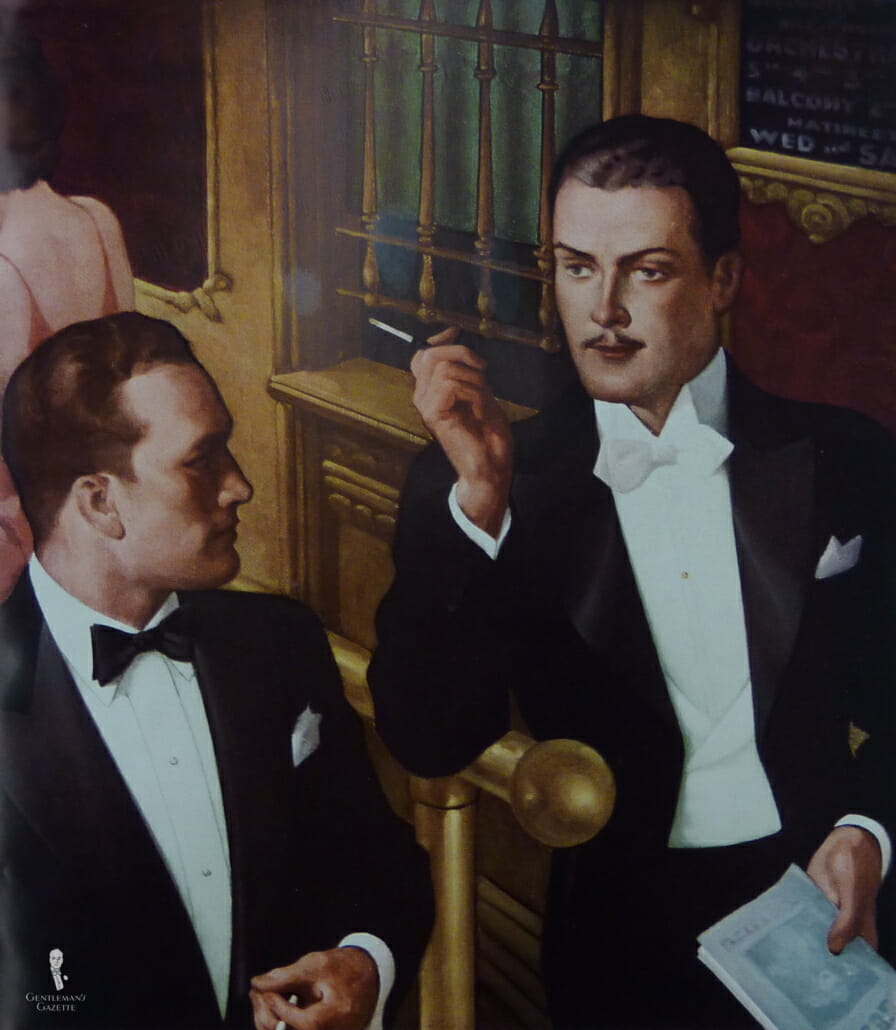
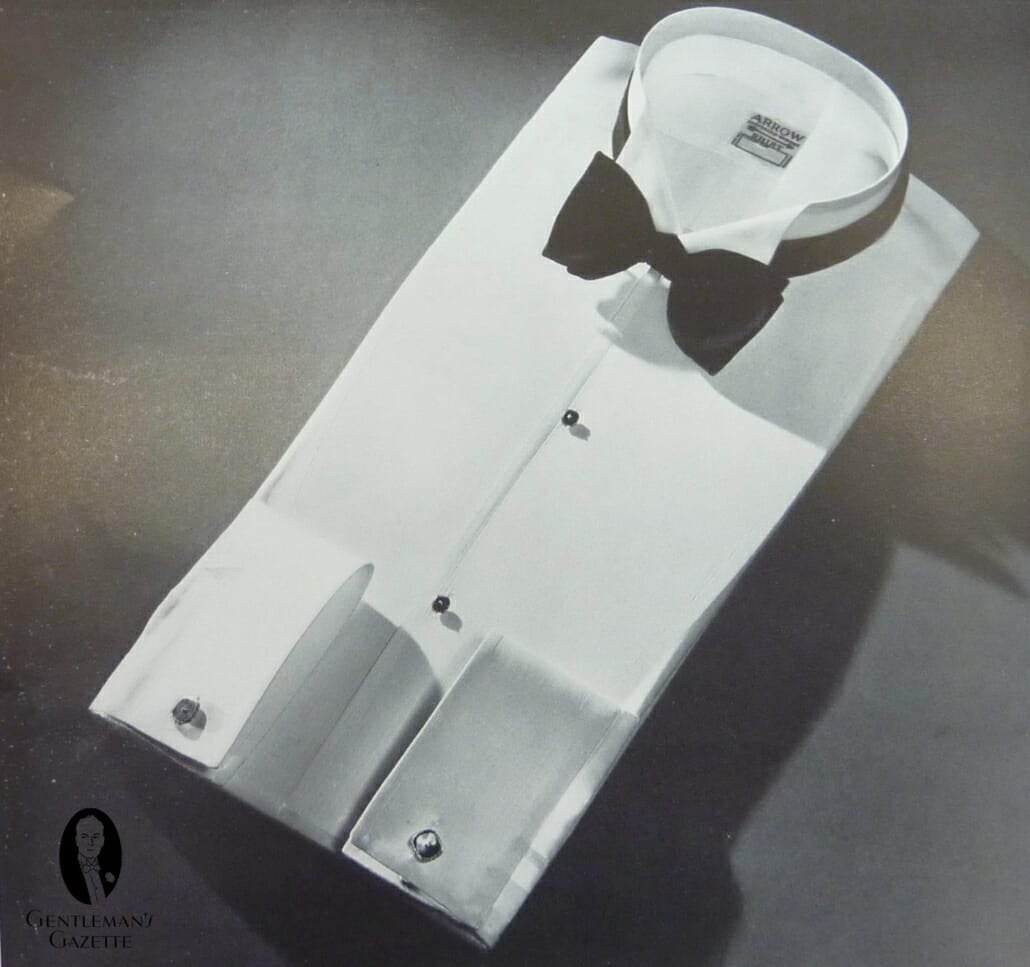
My subsequent research into the history of evening wear revealed that this shirt was not a television novelty but the true black-tie shirt. The tuxedo jacket had originated simply as an informal replacement for the tailcoat and was consequently worn with the tailcoat’s usual accompaniments at first: a white bow tie, white waistcoat and a stiffly starched shirt with a high standing detachable wing collar. Only with time did the jacket take on its own unique accompaniments. By World Word I it had become associated with black versions of the tailcoat’s bow tie and waistcoat. Then in the interwar period it gained a number of unique variations that better suited its role as “semi-formal” evening wear. This included a shirt with a softer front, flashier French cuffs and a more laid-back turndown collar.
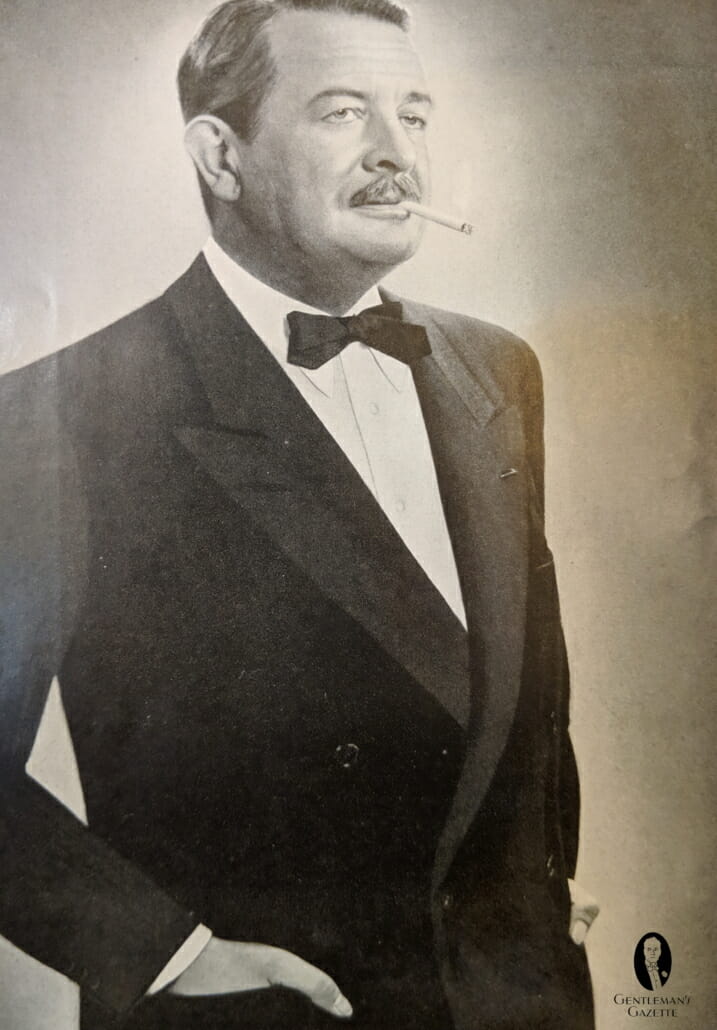
Originally intended for only the most informal occasions, after the Second World War the new shirt became the black-tie norm. It was perceived as more modern than the Victorian stiff wing collar as well as more practical for laundering. Some people also found it more attractive as it hid the contrasting black band of the bow tie, a consideration that did not apply to the white bow tie worn with the tailcoat. Thus by the 1950s wing collars had become virtually exclusive to White Tie.
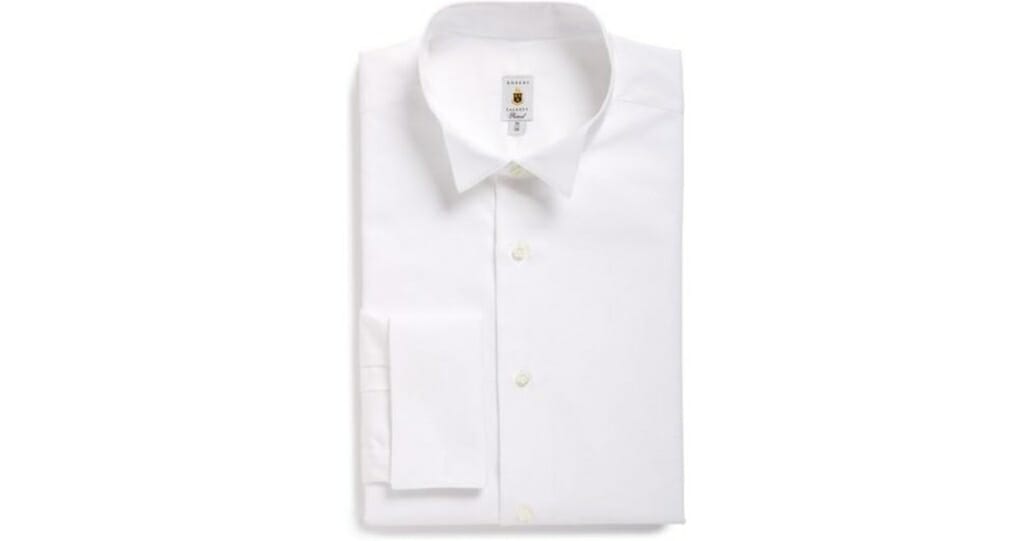
This black and white division of collar types worked just fine until the arrival of a 1970s hybrid that greyed the boundaries. The new shirt had all the features of the black-tie garment except for the collar which was an attached version of the wing collar. At first it was a reasonable facsimile of the aristocratic original’s stiff, tall stature and broad, bold wings but by the 1980s it had shrunk to plebeian portions. British men would have nothing to do with the shrunken and flaccid substitute but for some odd reason American men couldn’t get enough of it.
Well, mainstream American men. The country’s political and social elite continued to prefer the understated turndown collar (and self-tied bow tie) and this distinction remains today. Therefore when you plan your next black-tie outfit you would be wise to consider which look you prefer: the governing class or the class of ’85.

________________________________________
Formal Fact: “Wing tips” are for shoes, not shirts. If you encounter a formalwear retailer using the term “wing tip collar” leave the store. Quickly.
Understanding that your criticism is leveled at the modern take on the wing collar, would you still agree that a detachable wing collar paired with black tie and a white waistcoat is sophisticated enough for events that used to be considered white-tie appropriate (e.g. certain on-the-town New Year’s Eve activities)?
Definitely. My partner wears that combination frequently and it looks stunning.
I wouldn’t be too confident of depending on “The West Wing” as a source of sartorial authority based on the photo that you provided at the top of the page. The oxymoronic combination of a black-tie dinner jacket with notched lapels seems to be ubiquitous at American formal events these days. There’s no point bemoaning the introduction of the hybrid collar if you’re willing to overlook the absence of notched lapels. Even worse, take a look at the length of Romney’s white waistcoat at the 2012 Alfred Smith dinner; the ‘elite’ Americans can’t even get the white-tie events right!
Kind Regards,
Tim
Of course should have read “absence of peaked lapels”.
Regards,
After a cruise on a Famous Ship with my Wife I looked at my fellow Brits and our so called brothers from over there ,and said can any one educate these middle of the road turkeys that the wings on wing collar shirts must be above the BOW and also Please keep the one button of the Dinner jacket Fastened at all times ,Except when you get your cloak or any ticket from the pleats of
your Cummerbund (if you are wearing one)
The wing was put on the stiff collar so as to tuck your Serviette in to your neck then over the wing to hang down the front of the shirt to keep any thing you dropped ,Soup perhaps off the front of your kit.
Please with all your pretensions of greatness that you have lots of money in your pockets fellow travellers, Start to learn a few etiquette before you leave the planet for Hell.
I know this comments is a good four years old, but do you have a source for that the collar wings should be above the bow tie? I’d really love for you to be correct; I much prefer that way.
Esquire November and January 1940, and Style and the Man are the only written references I’ve found to how to place the wings vis a vis the bow tie and they all said to place wings in front of the tie. Style and the Man: “Bow ties are always worn in front of the wing collar. The original collars were bone hard, and therefore it was impossible to place their parts over the bow.”
In addition, in surveying the hundreds (thousands?) of historical images I have on file, I discovered the following trends regarding wing placement with bow ties:
-Victorian era: when wings are first introduced collars are so high and wings so small that they typically sit above (not behind or in front of) bow ties
-1910s: mostly poke collars, some tiny wing collars in front of tie
-1920s: many examples of wings in front of tie with black tie up until 1928, but no examples found with white tie
-1930s: wings become very broad; no examples of wings in front of tie for either black tie or white tie (wings are always behind tie)
-1940s: wings now only worn with white tie and always behind tie
Ouch! … The late great Hardy Amies once said to me that winged collar shirts are worn mainly by 14 year old Etonians or Germans! … So if you’re educating your fellow Brits, or anyone else for that matter, remind them of the fact that they’re actually considered rather ‘tacky’ … You won’t catch anyone on the Row’ wearing them, and of course they would be using Napkins NOT serviettes!
It is so wrong to tuck your napkin into your collar. Napkins go on your knee. They are not a bib. .
When wearing a wing collar shirt for black tie or white tie, does the collar have to detachable or was that just how it started and now it is ok if the collar is sewn onto the shirt? Thank you.
It’s how it started. Most(all?) shirts had detachable collars originally.
Debrett’s say that one should not wear a winged collar with Black Tie but other authorities suggest that it is acceptable. Personally I rather like a winged collar.